
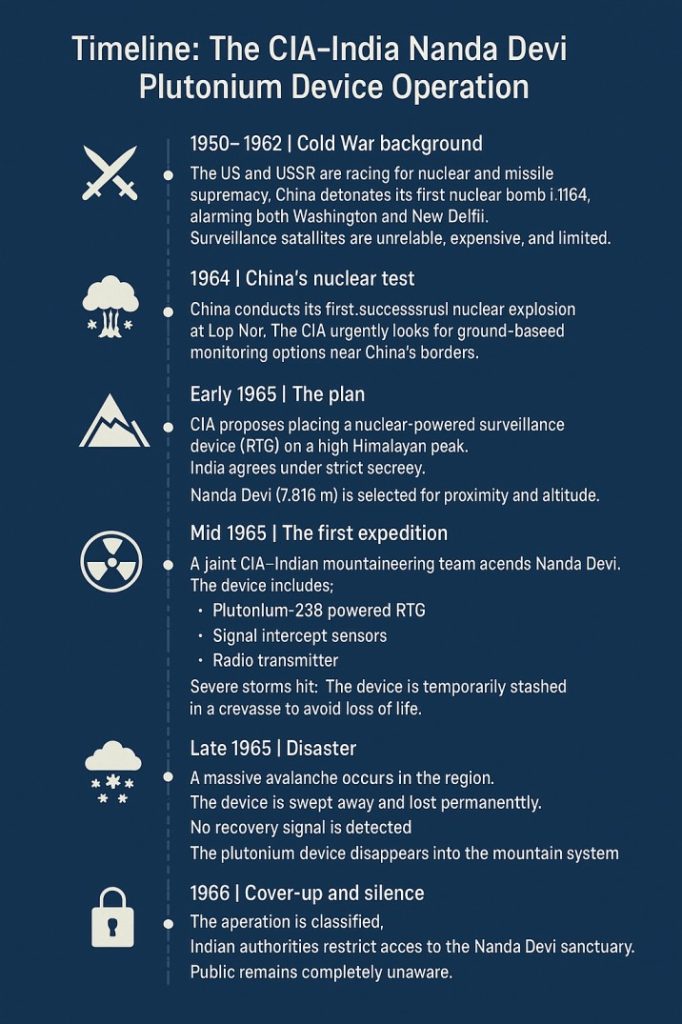
In the mid-1960s, long before satellites, drones, and real-time surveillance, global superpowers used an unlikely tool for spying – the Himalayas. One of the strangest episodes of the Cold War unfolded on Nanda Devi, India’s second-highest peak, involving a nuclear-powered surveillance device, not a bomb, secretly planted by the CIA with India’s cooperation.
Decades later, rumours, exaggerations, and outright falsehoods continue to circulate. This article separates fact from fiction, explains what the device actually was, and critically examines the realistic environmental and health risks involved.
What Exactly Was the Nanda Devi Plutonium Device?
The device was a radioisotope thermoelectric generator (RTG), similar to those used in space missions.
- It used Plutonium-238, not weapons-grade plutonium.
- It was not a nuclear bomb.
- It could not explode or trigger a chain reaction.
Plutonium-238 generates heat through radioactive decay. That heat is converted into electricity, which powered sensors and transmitters designed to monitor Chinese missile and nuclear test signals.
At the time, satellite surveillance was unreliable. High-altitude human placement was considered cutting-edge intelligence work.
Why Nanda Devi Was Chosen
Nanda Devi sits close to the Tibetan plateau and western China, making it strategically ideal.
Key reasons:
- Extreme altitude allowed line-of-sight signal interception
- Remote and restricted access reduced discovery risk
- India-US intelligence cooperation was active post-1962 war
In 1965, a joint CIA–Indian expedition attempted to install the device near the summit. Severe weather forced the team to stash the device in a crevasse, intending to retrieve it later.
They never did.
An avalanche is believed to have carried the device deeper into the mountain system. It has never been recovered.
What Were the Real Risks of This Device?
This is where truth matters more than panic.
1. Localised Radioactive Contamination
Plutonium-238 emits alpha radiation.
- Alpha radiation cannot penetrate skin
- It becomes dangerous only if inhaled or ingested
If the RTG casing ruptured:
- Nearby snow, ice, or soil could be contaminated
- Risk would remain highly localised
- No wide-area radiation spread is possible
This is not Hiroshima-type radiation. It is microscopic particulate risk.
2. Long-Term Persistence in the Environment
Plutonium-238 has a half-life of about 88 years.
That means:
- It decays slowly
- Any leaked material can persist for centuries
- Cold glacial environments slow both decay and movement
The Himalayas can act like a deep freezer, trapping contamination rather than spreading it rapidly.
3. Glacier and River System Concerns
One frequently repeated fear is contamination of the Ganga river system.
Theoretical pathway:
Nanda Devi → Rishi Ganga → Alaknanda → Ganga
Reality check:
- Meltwater dilution would be enormous
- No peer-reviewed study has detected plutonium traces linked to this device
- No measurable radioactive spike has been recorded downstream
So far, this remains speculative, not proven.
4. Risk to Climbers and Locals
Risk to local populations is extremely low.
Potential exposure scenarios are limited to:
- Direct contact with fragments
- Inhalation of radioactive dust during a rare exposure event
Given the terrain, this is statistically negligible. It is quite literally a needle buried in a mountain range.
5. Ethical and Political Damage
Arguably the most serious impact was not environmental.
This incident:
- Normalised dumping nuclear material in fragile ecosystems
- Treated mountains as disposable intelligence assets
- Reflected Cold War arrogance over ecological responsibility
It set a poor precedent, even if consequences were limited.
What the Device Did NOT Do
Let’s kill the myths properly.
- No nuclear explosion occurred
- No chain reaction possible
- No confirmed river poisoning
- No mass radiation exposure
- No proven cancer clusters
- No ongoing radiation emergency
Claims of “India’s hidden nuclear disaster” are fiction, not science.
Why Plutonium-238 Was Used
Plutonium-238 was chosen because:
- It produces steady heat
- It is unsuitable for nuclear weapons
- It was already used in US space missions
Ironically, the same technology powers spacecraft exploring the outer solar system. On Earth, however, nature is less cooperative.
Disaster or Overblown Fear?
The truth sits in the uncomfortable middle.
- Worst-case scenario: small, localised contamination
- Most likely scenario: device entombed in ice, slowly degrading
- Proven outcome: an embarrassing Cold War gamble
The Himalayas absorbed human ambition and quietly moved on.
This episode reminds us that before GPS, satellites, and ethics committees, intelligence agencies relied on risk, secrecy, and hope. Hope, especially in the mountains, is not a strategy.
Why This Story Still Matters Today
Because it teaches three hard lessons:
- Technology without foresight creates long shadows
- Nature is not a storage locker
- Truth matters more than patriotic myth-making
Cold War geopolitics may be history, but environmental accountability is not.