
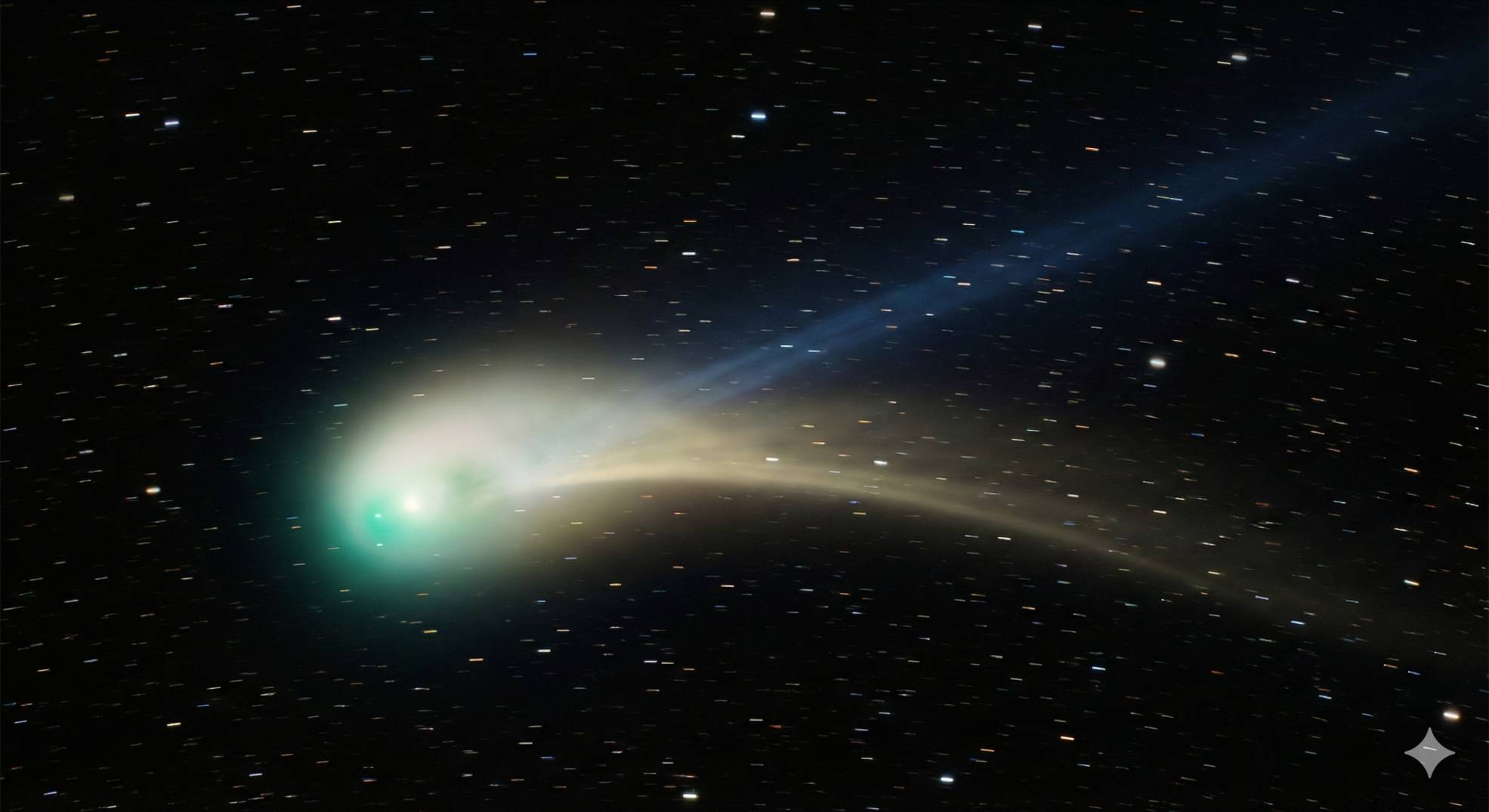
Interstellar Comet 3I/ATLAS: What Science Knows, What It Doesn’t, and Why Alien Claims Collapse
Every time something unfamiliar passes through our solar system, the internet does what it does best – panics, fantasises, and invents aliens.
The interstellar object 3I/ATLAS is the latest victim of this pattern.
Let’s slow down, breathe, and look at what evidence actually says.
What is 3I/ATLAS?
3I/ATLAS is the third confirmed interstellar object detected passing through our solar system, after ‘Oumuamua (2017) and 2I/Borisov (2019). It was discovered on 1 July 2025 by the ATLAS survey, a NASA-funded early warning system designed to spot near-Earth objects.
Its trajectory is hyperbolic, meaning it is not gravitationally bound to the Sun. It came from outside our solar system and will leave it forever. That fact alone makes it rare and scientifically valuable – but not mysterious.
NASA’s official position
NASA classifies 3I/ATLAS as an active interstellar comet. Observations from multiple space and ground-based telescopes show:
- A clear coma surrounding the nucleus
- Dust and gas tails produced by solar heating
- Outgassing of common cometary molecules such as water vapour, carbon monoxide, and carbon dioxide
These are textbook comet behaviours. No sharp edges. No symmetry. No engineered structure. Just ice, dust, heat, and physics doing their job.
NASA has also confirmed that the comet poses no threat to Earth and passes well outside Earth’s orbit.
About the so-called “signals”
Some social media posts and fringe commentary claimed that 3I/ATLAS was emitting a “signal”. This is where scientific illiteracy enters the chat.
What was detected were natural radio emissions from hydroxyl (OH) molecules. These form when sunlight breaks apart water molecules in a comet’s coma. Astronomers have observed this phenomenon for decades.
Multiple SETI and technosignature searches checked for artificial radio patterns. None were found. Zero. End of story.
Independent science backs the boring answer
Independent studies using spectroscopy and polarimetry suggest that 3I/ATLAS contains primitive carbon-rich material, likely formed around another star billions of years ago. Some of its chemical ratios are unusual compared to solar system comets – which is exactly what you would expect from an object born elsewhere.
“Unusual” in science does not mean “artificial”. It means data worth studying, not mythology worth spreading.
Why alien narratives keep returning
There’s a pattern here.
Unfamiliar object → incomplete data → loud speculation → clickbait → conspiracy.
Alien explanations are emotionally satisfying. They feel exciting. They flatter human importance. But science doesn’t care about excitement. It cares about repeatable evidence, physical laws, and Occam’s razor.
So far, every measurable property of 3I/ATLAS fits comfortably within known astrophysics.
Why 3I/ATLAS still matters
Calling it “just a comet” misses the point.
3I/ATLAS is a sample of another star system, delivered to us for free by gravity. It helps scientists understand:
- How planetary systems form elsewhere
- What interstellar material looks like chemically
- How common such visitors may be
This is real wonder. Real discovery. No aliens required.
The rational takeaway
Extraordinary claims require extraordinary evidence.
3I/ATLAS offers none that support alien technology or intelligence.
What it offers instead is something better – a reminder that the universe is vast, natural, and governed by laws that reward patience, skepticism, and clear thinking.
Wonder does not need superstition.
Curiosity does not need fantasy.
Science is enough.
Rational Thoughts
Promoting science, skepticism, and evidence over noise.